GALNT10 Antibody
Catalog# : 5279
Protein glycosylation is an important biological process that is carried out by a large family of glycosyltransferases that catalyze the synthesis of oligosaccharides and glycoconjugates. Polypeptide GalNAc transferases initiate the synthesis of mucin-type oligosaccharides by transferring GalNAc from UDP-GalNAc to the hydroxyl group of either a serine or threonine residue on the polypeptide acceptor. Polypeptide galactoaminyltransferase 10 (GALNT10) belongs to the polypeptide N-acetylgalactosaminyl-transferase (pp-GalNAc-T) protein family. Following expression in insect cells, recombinant GALNT10 showed significant GalNAcT activity toward mucin-derived peptides, and it utilized both non-glycosylated and glycosylated peptide substrates. GALNT10 mRNA is highly expressed in several distinct hypothalamic, thalamic, and amygdaloid nuclei in mouse brain. At least four isoforms of GALNT10 are known to exist.
Additional Names : GALNT10 (CT),Polypeptide galactoaminyltransferase 10, GalNAc transferase 10
 Description
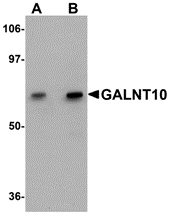
Left: Western blot analysis of GALNT10 in SK-N-SH cell lysate with GALNT10 antibody at (A) 1 and (B) 2 µg/ml.
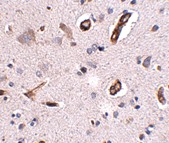
Below: Immunohistochemistry of GALNT10 in human brain tissue with GALNT10 antibody at 2.5 μg/ml.
Other Product Images
 Source : GALNT10 antibody was raised against an 18 amino acid peptide near the carboxy terminus of human GALNT10.
Purification : Affinity chromatography purified via peptide column
Clonality and Clone : Polyclonal
Host : GALNT10 antibody was raised in rabbit. Please use anti-rabbit secondary antibodies.
Application : GALNT10 antibody can be used for detection of GALNT10 by Western blot at 1 - 2 µg/ml.
Tested Application(s) : E, WB
Buffer : Antibody is supplied in PBS containing 0.02% sodium azide.
Blocking Peptide : Cat.No. 5279P - GALNT10 Peptide
Long-Term Storage : GALNT10 antibody can be stored at 4ºC, stable for one year. As with all antibodies care should be taken to avoid repeated freeze thaw cycles. Antibodies should not be exposed to prolonged high temperatures.
Positive Control
1. Cat. No. 1220 - SK-N-SH Cell Lysate
Species Reactivity :H, M, R
GI Number : 38195091
Accession Number : NP_938080
Short Description : (CT) Polypeptide galactoaminyltransferase 10
References
1. Amado M, Almeida R, Schwientek T, et al. Identification and characterization of large galactosyltransferase gene families: galactosyltransferases for all functions. Biochim. Biophys. Acta 1999; 1473:35-53.
2. Nelson PA, Sutcliffe JG, and Thomas EA. A new UDP-GalNAc:polypeptide N-acetylgalactosaminyltransferase mRNA exhibits predominant expression in the hypothalamus, thalamus and amygdala for mouse forebrain. Gene Express. Patterns 2002; 1:95-9.
FNIP2 Antibody
Catalog# : 5057
FNIP2 is the second protein found to interact with folliculin, the product of the Birt-Hogg-Dube (BHD) gene. Folliculin is thought to act as a tumor suppressor as mutations or loss of heterozygosity in this gene are associated with BHD syndrome-related renal tumors. Folliculin and FNIP1, a protein that shares 49% identity to FNIP2, bind to AMPK, an important energy sensor in cells that negatively regulates the mammalian target of rapamycin (mTOR), a protein that is thought to be the master switch for cell growth and proliferation. FNIP1 and FNIP2 are able to form homo- and heteromeric multimers, suggesting these proteins may have a functional relationship. Multiple isoforms of FNIP2 are known to exist. This antibody is predicted to not cross-react with FNIP1.
Additional Names : FNIP2 (NT), Folliculin interacting protein 2, FNIPL

Description
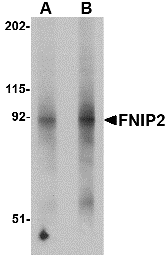
Left: Western blot analysis of FNIP2 in mouse skeletal muscle lysate with FNIP2 antibody at (A) 1 and (B) 2 µg/ml.
Source : FNIP2 antibody was raised against an 18 amino acid peptide near the amino terminus of human FNIP2.
Purification : Affinity chromatography purified via peptide column
Clonality and Clone : This is a polyclonal antibody.
Host : FNIP2 antibody was raised in rabbit. Please use anti-rabbit secondary antibodies.
Application : FNIP2 antibody can be used for detection of FNIP2 by Western blot at 1 – 2 µg/ml.
Tested Application(s) : E, WB
Buffer : Antibody is supplied in PBS containing 0.02% sodium azide.
Blocking Peptide : Cat.No. 5057P - FNIP2 Peptide
Long-Term Storage : FNIP2 antibody can be stored at 4ºC, stable for one year. As with all antibodies care should be taken to avoid repeated freeze thaw cycles. Antibodies should not be exposed to prolonged high temperatures.
Positive Control
1. Cat. No. 1407 - Mouse Skeletal Muscle Tissue Lysate
Species Reactivity :H, M, R
GI Number : 154689769
Accession Number : NP_065891
Short Description : (NT) Folliculin interacting protein 2
References
1. Hasumi H, Baba M, Hong S-B, et al. Identification and characterization of a novel folliculin-interacting protein FNIP2. Gene 2008; 415:60-7.
2. Takagi Y, Kobayashi T, Shiono M, et al. Interaction of folliculin (Birt-Hogg-Dube gene product) with novel Fnip1-like (FnipL/Fnip2) protein. Oncogene 2008; 27:5339-47.
3. Vocke CD, Yang Y, Pavlovich CP, et al. High frequency of somatic frameshift BHD mutations in Birt-Hogg-Dube-associated renal tumors. J. Natl. Cancer Inst. 2005; 97:931-5.
4. Baba M, Hong SB, Sharma M, et al. Folliculin encoded by the BHD gene interacts with a binding protein, FNIP1, and AMPK, and is involved in AMPK and mTOR signaling. Proc. Natl. Acad. Sci. USA 2006; 103:15552-7.
DNA replication is the process of copying a double-stranded DNA molecule to form two double-stranded molecules. The process of DNA replication is a fundamental process used by all living organisms as it is the basis for biological inheritance.
DNA Replication
The process of DNA replication is a fundamental process used by all living organisms as it is the basis for biological inheritance. As each DNA strand holds the same genetic information, both strands can serve as templates for the reproduction of the opposite strand. The template strand is preserved in its entirety and the new strand is assembled from nucleotides. This process is called "semiconservative replication". The resulting double-stranded DNA molecules are identical; proofreading and error-checking mechanisms exist to ensure near perfect fidelity.
Semiconservative Replication
Semiconservative replication describes the method by which DNA is replicated in all known cells. This method of replication was one of three proposed models of DNA replication: a)Conservative replication would leave the two original template DNA strands together in a double helix and would produce a copy composed of two new strands containing all of the new DNA base pairs. b) Dispersive replication would produce two copies of the DNA, both containing distinct regions of DNA composed of either both original strands and both new strands.
Read more: DNA Replication
A DNA polymerase is an enzyme that assists in DNA replication. Such enzymes catalyze the polymerization of deoxyribonucleotides alongside a DNA strand, they "read" and use as a template. The newly-polymerized molecule is complementary to the template strand and identical to the template's partner strand.
Polymerase Chain Reaction
The polymerase chain reaction (PCR) is a technique widely used in molecular biology. It derives its name from one of its key components, a DNA polymerase used to amplify a piece of DNA by in vitro enzymatic replication. As PCR progresses, the DNA thus generated is itself used as a template for replication. This sets in motion a chain reaction in which the DNA template is exponentially amplified.
RNA Polymerase
RNA polymerase (RNAP or RNApol) is an enzyme that makes an RNA copy of a DNA or RNA template. In cells, RNAP is needed for constructing RNA chains from DNA genes, a process called transcription.
FNIP2 Antibody
Catalog# : 5045
FNIP2 is the second protein found to interact with folliculin, the product of the Birt-Hogg-Dube (BHD) gene. Folliculin is thought to act as a tumor suppressor as mutations or loss of heterozygosity in this gene are associated with BHD syndrome-related renal tumors. Folliculin and FNIP1, a protein that shares 49% identity to FNIP2, bind to AMPK, an important energy sensor in cells that negatively regulates the mammalian target of rapamycin (mTOR), a protein that is thought to be the master switch for cell growth and proliferation. FNIP1 and FNIP2 are able to form homo- and heteromeric multimers, suggesting these proteins may have a functional relationship. Multiple isoforms of FNIP2 are known to exist. This antibody is predicted to not cross-react with FNIP1.
Additional Names : FNIP2 (CT), Folliculin interacting protein 2, FNIPL
 Description
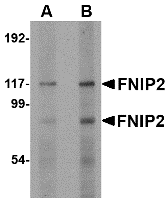
Left: Western blot analysis of FNIP2 in rat skeletal muscle lysate with FNIP2 antibody at (A) 1 and (B) 2 µg/ml.
Source : FNIP2 antibody was raised against a 16 amino acid peptide near the carboxy terminus of human FNIP2.
Purification : Affinity chromatography purified via peptide column
Clonality and Clone : This is a polyclonal antibody.
Host : FNIP2 antibody was raised in rabbit. Please use anti-rabbit secondary antibodies.
Application : FNIP2 antibody can be used for detection of FNIP2 by Western blot at 1 – 2 µg/ml.
Tested Application(s) : E, WB
Buffer : Antibody is supplied in PBS containing 0.02% sodium azide.
Blocking Peptide : Cat.No. 5045P - FNIP2 Peptide
Long-Term Storage : FNIP2 antibody can be stored at 4ºC, stable for one year. As with all antibodies care should be taken to avoid repeated freeze thaw cycles. Antibodies should not be exposed to prolonged high temperatures.
Positive Control
1. Cat. No. 1467 - Rat Skeletal Muscle Tissue Lysate
Species Reactivity :H, M, R
GI Number : 154689769
Accession Number : NP_065891
Short Description : (CT) Folliculin interacting protein 2
References
1. Hasumi H, Baba M, Hong S-B, et al. Identification and characterization of a novel folliculin-interacting protein FNIP2. Gene 2008; 415:60-7.
2. Takagi Y, Kobayashi T, Shiono M, et al. Interaction of folliculin (Birt-Hogg-Dube gene product) with novel Fnip1-like (FnipL/Fnip2) protein. Oncogene 2008; 27:5339-47.
3. Vocke CD, Yang Y, Pavlovich CP, et al. High frequency of somatic frameshift BHD mutations in Birt-Hogg-Dube-associated renal tumors. J. Natl. Cancer Inst. 2005; 97:931-5.
4. Baba M, Hong SB, Sharma M, et al. Folliculin encoded by the BHD gene interacts with a binding protein, FNIP1, and AMPK, and is involved in AMPK and mTOR signaling. Proc. Natl. Acad. Sci. USA 2006; 103:15552-7.
FABP7 Antibody
Catalog# : 4259
FABP7 was initially isolated from a human fetal brain cDNA library and whose mRNA was expressed in adult brain and muscle tissues at low levels. The protein encoded by this gene is a member of the fatty acid binding protein (FABPs) family, a group of small, highly conserved, cytoplasmic proteins that bind long-chain fatty acids and other hydrophobic ligands. FABPs are thought to play roles in fatty acid uptake, transport, and metabolism. FABP7 is a downstream gene of the Pax6 transcription factor and has been suggested to be essential for the maintenance of neuroepithelial cells during early cortical development. More recently, FABP7 was found to be frequently expressed in melanomas. Down-regulation of FABP7 through RNAi expression could reduce in vitro cell proliferation and Matrigel invasion, suggesting that FABP7 may be a potential target for the development of diagnostic and therapeutic tools.
Additional Names : FABP7 (IN), Fatty acid binding protein 7, B-FABP, MRG, BLBP
 Description
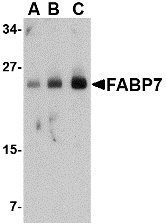
Left: Western blot analysis of FABP7 in human breast tissue lysate with FABP7 antibody at (A) 0.5, (B) 1 and (C) 2 µg/ml.
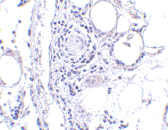
Below: Immunohistochemistry of FABP7 in human breast tissue with FABP7 antibody at 5 µg/ml.
Other Product Images
 Source : FABP7 antibody was raised against a 17 amino acid peptide from near the center of human FABP7.
Purification : Affinity chromatography purified via peptide column
Clonality and Clone : This is a polyclonal antibody.
Host : FABP7 antibody was raised in rabbit. Please use anti-rabbit secondary antibodies.
Application : FABP7 antibody can be used for detection of FABP7 by Western blot at 0.5 – 1 µg/ml.
Tested Application(s) : E, WB, IHC
Buffer : Antibody is supplied in PBS containing 0.02% sodium azide.
Blocking Peptide : Cat.No. 4259P - FABP7 Peptide
Long-Term Storage : FABP7 antibody can be stored at 4ºC, stable for one year. As with all antibodies care should be taken to avoid repeated freeze thaw cycles. Antibodies should not be exposed to prolonged high temperatures.
Positive Control
1. Cat. No. 1311 - Human Breast Tissue Lysate
Species Reactivity :H
GI Number : 119568551
Accession Number : EAW48166
Short Description : (IN) Fatty acid binding protein 7
References
1. Shimizu F, Watanabe TK, Shinomiya H, et al. Isolation and expression of a cDNA for human brain fatty acid-binding protein (B-FABP). Biochim. Biophys. Acta 1997; 1354:24-8.
2. Chmurzynska A. The multigene family of fatty acid-binding proteins (FABPs): function, structure and polymorphism. J. Appl. Genet. 2006; 47:39-48.
3. Arai Y, Funatsu N, Numayama-Tsuruta K, et al. Role of FABP7, a downstream gene of pax6, in the maintenance of neuroepithelial cells during early embryonic development of the rat cortex. J. Neurosci. 2005; 25:9752-61.
4. Goto Y, Matsuzaki Y, Kurihara S, et al. A new melanoma antigen fatty acid-binding protein 7, involved in proliferation and invasion, is a potential target for immunotherapy and molecular target therapy. Cancer Res. 2006; 66:4443-9.
EVER2 Antibody
Catalog# : 4605
Epidermodysplasia verruciformis (EV) is an autosomal recessive genodermatosis associated with a high risk of skin cancers resulting from a high susceptibility to infection by specific human papillomaviruses. Mutations in two homologous genes EVER1 and EVER2 cause the majority of EV cases. These two proteins form a complex and interact with the zinc transporter ZnT-1 in the endoplasmic reticulum. Cells lacking EVER2 accumulated higher levels of zinc in the nucleolus and nucleus compare to those cells with and intact EVER2 gene, indicating that one role of EVER2 is to regulate the intracellular distribution of zinc. At least three isoforms of EVER2 are known to exist; this antibody will only recognize the larger isoform. EVER2 has no cross-reactivity to EVER1.
Additional Names : EVER2 (IN), Transmembrane channel-like protein 8, TMC8
 Description
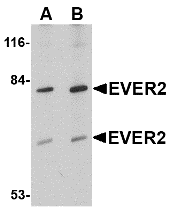
Left: Western blot analysis of EVER2 in Jurkat cell lysate with EVER2 antibody at (A) 1 and (B) 2 µg/ml.
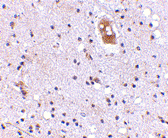
Below: Immunohistochemistry of EVER2 in human brain with EVER2 antibody at 5 µg/ml.
Other Product Images
 Source : EVER2 antibody was raised against a 14 amino acid peptide from near the center of human EVER2.
Purification : Affinity chromatography purified via peptide column
Clonality and Clone : This is a polyclonal antibody.
Host : EVER2 antibody was raised in rabbit. Please use anti-rabbit secondary antibodies.
Application : EVER2 antibody can be used for detection of EVER2 by Western blot at 1 – 2 µg/ml.
Tested Application(s) : E, WB, IHC
Buffer : Antibody is supplied in PBS containing 0.02% sodium azide.
Blocking Peptide : Cat.No. 4605P - EVER2 Peptide
Long-Term Storage : EVER2 antibody can be stored at 4ºC, stable for one year. As with all antibodies care should be taken to avoid repeated freeze thaw cycles. Antibodies should not be exposed to prolonged high temperatures.
Positive Control
1. Cat. No. 1205 - Jurkat Cell Lysate
Species Reactivity :H, M, R
GI Number : 25527192
Accession Number : AAM44454
Short Description : Transmembrane channel-like protein 8
References
1. Ramoz N, Taieb A, Rueda L-A, et al. Evidence for a nonallelic heterogeneity of epidermodysplasia verruciformis with two susceptibility loci mapped to chromosome regions 2p21-p24 and 17q25. J. Invest. Dermatol. 2000; 114:1148-53.
2. Ramoz N, Rueda L-A, Bouadjar B, et al. Mutations in two adjacent novel genes are associated with epidermodysplasia verruciformis. Nat. Genet. 2002; 32:579-81.
3. Lazarczyk M, Pons C, Mendoza J-A, et al. Regulation of cellular zinc balance as a potential mechanism of EVER-mediated protection against pathogenesis by cutaneous oncogenic human papillomaviruses. J. Exp. Med. 2008; 205:35-42.
EVER2 Antibody
Catalog# : 4657
Epidermodysplasia verruciformis (EV) is an autosomal recessive genodermatosis associated with a high risk of skin cancers resulting from a high susceptibility to infection by specific human papillomaviruses. Mutations in two homologous genes EVER1 and EVER2 cause the majority of EV cases. These two proteins form a complex and interact with the zinc transporter ZnT-1 in the endoplasmic reticulum. Cells lacking EVER2 accumulated higher levels of zinc in the nucleolus and nucleus compare to those cells with and intact EVER2 gene, indicating that one role of EVER2 is to regulate the intracellular distribution of zinc. At least two isoforms of EVER2 are known to exist; this antibody will only recognize the larger isoform. EVER2 has no cross-reactivity to EVER1.
Additional Names : EVER2 (NT), Transmembrane channel-like protein 8, TMC8
 Description
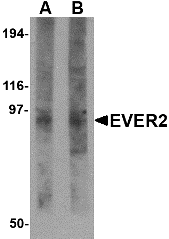
Left: Western blot analysis of EVER2 in rat thymus tissue lysate with EVER2 antibody at (A) 1 and (B) 2 µg/ml.
Source : EVER2 antibody was raised against a 18 amino acid peptide from near the amino terminus of human EVER2.
Purification : Affinity chromatography purified via peptide column
Clonality and Clone : This is a polyclonal antibody.
Host : EVER2 antibody was raised in rabbit. Please use anti-rabbit secondary antibodies.
Application : EVER2 antibody can be used for detection of EVER2 by Western blot at 1 – 2 µg/ml.
Tested Application(s) : E, WB
Buffer : Antibody is supplied in PBS containing 0.02% sodium azide.
Blocking Peptide : Cat.No. 4657P - EVER2 Peptide
Long-Term Storage : EVER2 antibody can be stored at 4ºC, stable for one year. As with all antibodies care should be taken to avoid repeated freeze thaw cycles. Antibodies should not be exposed to prolonged high temperatures.
Positive Control
1. Cat. No. 1471 - Rat Thymus Tissue Lysate
Species Reactivity :H, M, R
GI Number : 25527192
Accession Number : AAM44454
Short Description : Transmembrane channel-like protein 8
References
1. Ramoz N, Taieb A, Rueda L-A, et al. Evidence for a nonallelic heterogeneity of epidermodysplasia verruciformis with two susceptibility loci mapped to chromosome regions 2p21-p24 and 17q25. J. Invest. Dermatol. 2000; 114:1148-53.
2. Ramoz N, Rueda L-A, Bouadjar B, et al. Mutations in two adjacent novel genes are associated with epidermodysplasia verruciformis. Nat. Genet. 2002; 32:579-81.
3. Lazarczyk M, Pons C, Mendoza J-A, et al. Regulation of cellular zinc balance as a potential mechanism of EVER-mediated protection against pathogenesis by cutaneous oncogenic human papillomaviruses. J. Exp. Med. 2008; 205:35-42.
A DNA polymerase is an enzyme that assists in DNA replication. Such enzymes catalyze the polymerization of deoxyribonucleotides alongside a DNA strand, they "read" and use as a template. The newly-polymerized molecule is complementary to the template strand and identical to the template's partner strand. Polymerase Chain Reaction The polymerase chain reaction (PCR) is a technique widely used in molecular biology. It derives its name from one of its key components, a DNA polymerase used to amplify a piece of DNA by in vitro enzymatic replication. As PCR progresses, the DNA thus generated is itself used as a template for replication. This sets in motion a chain reaction in which the DNA template is exponentially amplified. RNA Polymerase RNA polymerase (RNAP or RNApol) is an enzyme that makes an RNA copy of a DNA or RNA template. In cells, RNAP is needed for constructing RNA chains from DNA genes, a process called transcription. RNA polymerase enzymes are essential to life and are found in all organisms and many viruses. In chemical terms, RNAP is a nucleotidyl transferase that polymerizes ribonucleotides at the 3' end of an RNA transcript.
Read More: DNA Polymerase Synthesizes

 Description
 Source : GALNT10 antibody was raised against an 18 amino acid peptide near the carboxy terminus of human GALNT10.