Bim Monoclonal Antibody
Catalog# : PM-4819
Members in the Bcl-2 family are critical regulators of apoptosis by either inhibiting or promoting cell death. Bcl-2 homology 3 (BH3) domain is a potent death domain. BH3 domain containing pro-apoptotic proteins, including Bad, Bax, Bid, Bik, and Hrk, form a growing subclass of the Bcl-2 family. Bim is another BH3 domain containing protein which can induce apoptosis. Bim interacts with diverse members in the pro-survival Bcl-2 sub-family including Bcl-2, Bcl-xL and Bcl-w. The messenger RNA of Bim is ubiquitously expressed in multiple tissues and cell lines.
Additional Names : Bim (1C2C8): Bcl-2 interacting protein, Bcl-2-related ovarian death gene, BOD, Bcl-2-like 11
 Description
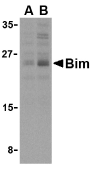
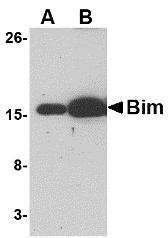
Left: Western blot analysis of (A) 5 and (B) 25 ng of Bim recombinant protein with Bim antibody at 1 µg/ml. Below: Immunocytochemistry of Bim in K562 cells with Bim antibody at 10 µg/ml.
Source :Mouse monoclonal Bim antibody was raised against a recombinant protein corresponding to amino acids 2 to 198 of human Bim.
Purification : Immunoaffinity chromotography purified IgG
Clonality and Clone : This is a monoclonal antibody. (Clone 1C2C8)
Host : Bim monoclonal antibody was raised in mouse.
Immunogen : Mouse monoclonal Bim antibody was raised against a recombinant protein corresponding to amino acids 2 to 198 of human Bim.
Tested Application(s) : E, WB, ICC
Buffer : Antibody is supplied in PBS containing 0.02% sodium azide.
Long-Term Storage : Bim monoclonal antibody can be stored at 4ºC, stable for one year.
Positive Control
- Cat. No. 95-107 - Bim Recombinant Protein
Species Reactivity :H, M
Short Description : A Bcl-2 interacting protein
References
- O'Connor L, Strasser A, O'Reilly LA, et al. Bim: a novel member of the Bcl-2 family that promotes apoptosis. EMBO J. 1998; 17:384-395.
- Hsu SY, Lin P, and Hsueh AJ BOD (Bcl-2-related ovarian death gene) is an ovarian BH3 domain-containing proapoptotic Bcl-2 protein capable of dimerization with diverse antiapoptotic Bcl-2 members. Mol. Endocrinol. 1998; 12:1432-40.
For more detail regarding Peptides please visit here : Custom Peptide Synthesis
Bim Antibody
Catalog# : 2065
Members in the Bcl-2 family are critical regulators of apoptosis by either inhibiting or promoting cell death. Bcl-2 homology 3 (BH3) domain is a potent death domain. BH3 domain containing pro-apoptotic proteins, including Bad, Bax, Bid, Bik, and Hrk, form a growing subclass of the Bcl-2 family. A novel BH3 domain containing protein was recently identified and designated Bim or BOD in human, mouse and rat (1,2). Bim/BOD interacts with diverse members in the pro-survival Bcl-2 sub-family including Bcl-2, Bcl-xL and Bcl-w. Bim/BOD induces apoptosis. The messenger RNA of Bim is ubiquitously expressed in multiple tissues and cell lines (1,2).
Additional Names : Bim (IN), BOD
 Description
Left: Western blot analysis of Bim in K562 (K) and A549 (A) whole cell lysates with Bim antibody at 1 µg/ml. Below: Immunohistochemistry of Bim in human skin cancer cells with Bim antibody at 20 µg/ml.
Source :Bim antibody was raised against a peptide corresponding to amino acids near the center of human Bim. The sequence is identical to that of mouse and differs from that of rat by one amino acid .
Purification : Affinity chromatography purified via peptide column
Clonality and Clone : This is a polyclonal antibody.
Host : Bim antibody was raised in rabbit.
Immunogen : Human Bim (Intermediate Domain) Peptide (Cat. No. 2065P)
Tested Application(s) : E, WB, IHC
Buffer : Antibody is supplied in PBS containing 0.02% sodium azide.
Blocking Peptide : Cat. No. 2065P - Bim Peptide
Long-Term Storage : Bim antibody can be stored at 4ºC, stable for one year. As with all antibodies care should be taken to avoid repeated freeze thaw cycles. Antibodies should not be exposed to prolonged high temperatures.
Positive Control
- Cat. No. 1204 - K562 Cell Lysate
Species Reactivity :H, M, R
GI Number : 18202042
Accession Number : O43521
Short Description : (IN) A new member in Bcl-2 family
References
- O'Connor L, Strasser A, O'Reilly LA, et al. Bim: a novel member of the Bcl-2 family that promotes apoptosis. EMBO J. 1998; 17:384-395.
- Hsu SY, Lin P, and Hsueh AJ BOD (Bcl-2-related ovarian death gene) is an ovarian BH3 domain-containing proapoptotic Bcl-2 protein capable of dimerization with diverse antiapoptotic Bcl-2 members. Mol. Endocrinol. 1998; 12:1432-40.
For more detail regarding Peptides please visit here : Custom Peptide Synthesis
Bim Antibody
Catalog# : 3405
Members in the Bcl-2 family are critical regulators of apoptosis by either inhibiting or promoting cell death. Bcl-2 homology 3 (BH3) domain is a potent death domain. BH3 domain containing pro-apoptotic proteins, including Bad, Bax, Bid, Bik, and Hrk, form a growing subclass of the Bcl-2 family. A novel BH3 domain containing protein was recently identified and designated Bim or BOD in human, mouse and rat (1,2). Bim/BOD interacts with diverse members in the pro-survival Bcl-2 sub-family including Bcl-2, Bcl-xL and Bcl-w. Bim/BOD induces apoptosis. The messenger RNA of Bim is ubiquitously expressed in multiple tissues and cell lines (1,2).
Additional Names : Bim (IN2), Bim, Bod
 Description
Left: Western blot analysis of Bim in K562 cell lysates with Bim antibody (IN2) at (A) 2.5 and (B) 5 µg/ml. Below: Immunocyochemistry of BIM in K562 cells with Bim antibody at 10 µg/ml.
Source : Bim antibody was raised against a peptide corresponding to amino acids near the center of human Bim The sequence is identical to that of mouse and rat.
Purification : Affinity chromatography purified via peptide column
Clonality and Clone : This is a polyclonal antibody.
Host : Bim antibody was raised in rabbit.
Immunogen : Human Bim (Intermediate Domain 2) Peptide (Cat. No. 3405P)
Tested Application(s) : E, WB, ICC
Buffer : Antibody is supplied in PBS containing 0.02% sodium azide.
Blocking Peptide : Cat. No. 3405P - Bim (IN2) Peptide
Long-Term Storage : Bim antibody can be stored at 4ºC, stable for one year. As with all antibodies care should be taken to avoid repeated freeze thaw cycles. Antibodies should not be exposed to prolonged high temperatures.
Positive Control
- Cat. No. 1204 - K562 Cell Lysate
Species Reactivity :H, M, R
GI Number : 20336315
Accession Number : NP_619527
Short Description : (IN2) An intermediate in the TLR and Bmp signaling pathways
References
- O'Connor L, Strasser A, O'Reilly LA, et al. Bim: a novel member of the Bcl-2 family that promotes apoptosis. EMBO J. 1998; 17:384-395.
- Hsu SY, Lin P, and Hsueh AJ BOD (Bcl-2-related ovarian death gene) is an ovarian BH3 domain-containing proapoptotic Bcl-2 protein capable of dimerization with diverse antiapoptotic Bcl-2 members. Mol. Endocrinol. 1998; 12:1432-40.
For more detail regarding Peptide please visit here : Custom Peptide Synthesis
Bik Antibody
Catalog# : 3819
Apoptosis plays a major role in normal organism development, tissue homeostasis, and removal of damaged cells and is caused by the activation of proteolytic enzymes termed caspases. Proteins that comprise the Bcl-2 family appear to control the activation of these enzymes. One such protein BIK was recently identified as an endoplasmic reticulum (ER)-residing pro-apoptotic member of the Bcl-2 homology domain-3 (BH3)-only group of the Bcl-2 family that stimulates mitochondrial release of cytochrome c following p53 induction of apoptosis. A significant fraction of BIK is found as an ER transmembrane protein, with most of the protein facing the cytosol. Restricting BIK to the ER membrane by replacing the transmembrane region with that of the ER-selective membrane anchor of cytochrome b(5) resulted in a decreased cytochrome c release from mitochondria and a corresponding drop in cell death. Recent evidence suggests that BIK cooperates with NOXA, another BH3-only protein, to somehow enhance the activation of Bax to stimulate the rapid release of cytochrome c from mitochondria.
Additional Names : Bik, Bcl-2-interacting killer, apoptosis inducer NBK
 Description
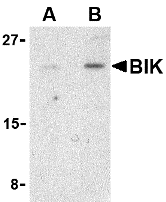
Left: Western blot analysis of BIK in Jurkat cell lysate with BIK antibody at (A) 1 and (B) 2 µg/ml. Below: Immunocytochemistry of BIK in Jurkat cells with BIK antibody at 1 µg/ml.
Source : BIK antibody was raised against a 15 amino acid peptide from near the amino terminus of human BIK.
Purification : Affinity chromatography purified via peptide column
Clonality and Clone : This is a polyclonal antibody.
Host : Bik antibody was raised in rabbit.
Tested Application(s) : E, WB, ICC
Buffer : Antibody is supplied in PBS containing 0.02% sodium azide.
Blocking Peptide : Cat.No. 3819P - Bik Peptide
Long-Term Storage : Bik antibody can be stored at 4ºC, stable for one year. As with all antibodies care should be taken to avoid repeated freeze thaw cycles. Antibodies should not be exposed to prolonged high temperatures.
Positive Control
- Cat. No. 1205 - Jurkat Cell Lysate
Species Reactivity :H, M
GI Number : 47678311
Accession Number : CAG30276
Short Description : a member of the Bcl-2 family
References
- Lockshin RA, Osborne B, and Zakeri Z. Cell death in the third millennium. Cell Death Differ. 2000; 7:2-7.
- Germain M, Mathai JP, and Shore GC. BH-3-only BIK functions at the endoplasmic reticulum to stimulate cytochrome c release from mitochondria. J. Biol. Chem. 277:18053-60.
- Germain M, Mathai JP, McBride HM, et al. Endoplasmic reticulum BIK initiates DRP1-regulated remodelling of mitochondrial cristae during apoptosis. EMBO J. 2005; 24:1546-56.
For more detail regarding Peptide please visit here : Custom Peptide Synthesis
Bif Antibody
Catalog# : 3817
Apoptosis plays a major role in normal organism development, tissue homeostasis, and removal of damaged cells and is caused by the activation of proteolytic enzymes termed caspases. Proteins that comprise the Bcl-2 family such as Bax appear to control the activation of these enzymes. Bax activity was found to be regulated by its association with Bax-interacting factor 1 (BIF), a member of the endophilin B family that is associated with intracellular membranes.. Following this interaction, Bax undergoes a conformational change and translocates to mitochondrial membranes. The Bax/BIF interaction appears to be enhanced by apoptotic stimuli, suggesting that BIF acts as the trigger to activate Bax, and as suppression of BIF promoted HeLa cell colony formation in soft agar, it may have a role in the suppression of cancer progression. At least two isoforms of BIF are known to exist.
Additional Names : Bif, Bax-interacting factor 1, endophilin B1
 Description
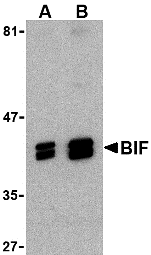
Left: Western blot analysis of BIF in HeLa cell lysate with BIF antibody at (A) 1 and (B) 2 µg/ml. Below: Immunocytochemistry of BIF in HeLa with BIF antibody at 10 µg/ml.
Source :BIF antibody was raised against a 15 amino acid peptide from near the carboxy terminus of human BIF.
Purification : Affinity chromatography purified via peptide column
Clonality and Clone : This is a polyclonal antibody.
Host : Bif antibody was raised in rabbit.
Tested Application(s) : E, WB, ICC
Buffer : Antibody is supplied in PBS containing 0.02% sodium azide.
Blocking Peptide : Cat.No. 3817P - Bif Peptide
Long-Term Storage : Bif antibody can be stored at 4ºC, stable for one year. As with all antibodies care should be taken to avoid repeated freeze thaw cycles. Antibodies should not be exposed to prolonged high temperatures.
Positive Control
Cat. No. 1201 - HeLa Cell Lysate
Species Reactivity :H, M
GI Number : 13469879
Accession Number : AAK27365
Short Description : a member of the Bcl-2 family
References
- Lockshin RA, Osborne B, and Zakeri Z. Cell death in the third millennium. Cell Death Differ. 2000; 7:2-7.
- Oltvai ZN, Milliman CL, and Korsmeyer SJ. Bcl-2 heterodimerizes in vivo with a conserved homolog, Bax, that accelerates programmed cell death. Cell 1993; 74:609-19.
- Cuddeback SM, Yamaguchi H, Komatsu K, et al. Molecular cloning and characterization of bif-1. J. Biol. Chem. 2001; 276:20559-65.
- Takahashi Y, Karbowski M, Yamaguchi H, et al. Loss of Bif-1 suppresses Bax/Bak conformational change and mitochondrial apoptosis. Mol. Cell. Biol. 2005; 25:9369-82.
For more detail regarding Peptide please visit here : Custom Peptide Synthesis
Bid Antibody
Catalog# : 3355
Apoptosis plays a major role in normal organism development, tissue homeostasis, and removal of damaged cells. Disruption of this process has been implicated in a variety of diseases such as cancer (reviewed in 1). The Bcl-2 family of proteins is comprised of critical regulators of apoptosis that can be divided into two classes: those that inhibit apoptosis and those that promote cell death (reviewed in 2 and 3). Bid, a pro-apoptotic Bcl-2 family member, is cleaved by caspase-8 in response to apoptotic signals (4,5), exposing the Bcl-2 homology 3 (BH3) domain which is normally buried in the full-length protein (6). The cleaved complex is myris-toylated and translocated to the mitochondrial membrane where it may induce mitochondrial Bax and Bak to oligomerize (7,8).
Additional Names : Bid (IN), Bid
 Description
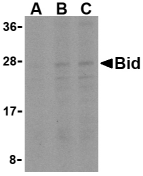
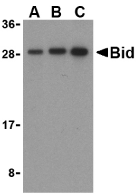
Left: Western blot analysis of Bid in A549 cell lysates with Bid antibody at (A) 0.5, (B) 1, and (C) 2 µg/ml.
Source : Bid antibody was raised against a peptide corresponding to 14 amino acids near the middle of human Bid.
Purification : Ion exchange chromatography purified
Clonality and Clone : This is a polyclonal antibody.
Host : Bid antibody was raised in rabbit.
Immunogen : Human Bid (IN) Peptide (Cat. No. 3355P)
Tested Application(s) : E, WB
Buffer : Antibody is supplied in PBS containing 0.02% sodium azide.
Blocking Peptide : Cat. No. 3355P - Bid Peptide
Long-Term Storage : Bid antibody can be stored at 4ºC, stable for one year. As with all antibodies care should be taken to avoid repeated freeze thaw cycles. Antibodies should not be exposed to prolonged high temperatures.
Positive Control
Cat. No. 1203 - A549 Cell Lysate
Species Reactivity :H, M
GI Number : 54673639
Accession Number : AAH36364
Short Description : (IN) a member of the bcl-2 family
References
- Lockshin RA, Osborne B, and Zakeri Z. Cell death in the third millennium. Cell Death Differ. 2000; 7:2-7.
- Cory S, Huang DCS, and Adams JM. The Bcl-2 family: roles in cell survival and oncogenesis. Oncogene 2003; 22:8590-607.
- Heiser D, Labi V, Erlacher M, et al. The Bcl-2 protein family and its role in the development of neoplastic disease. Exp. Geron. 2004; 39:1125-35.
- Wang K, Yin XM, Chao DT, et al. BID: a novel BH3 domain-only death agonist. Genes Dev. 1996; 10:2859-69.
For more detail regarding Peptide please visit here : Custom Peptide Synthesis
Bid Antibody
Catalog# : 3353
Apoptosis plays a major role in normal organism development, tissue homeostasis, and removal of damaged cells. Disruption of this process has been implicated in a variety of diseases such as cancer (reviewed in 1). The Bcl-2 family of proteins is comprised of critical regulators of apoptosis that can be divided into two classes: those that inhibit apoptosis and those that promote cell death (reviewed in 2 and 3). Bid, a pro-apoptotic Bcl-2 family member, is cleaved by caspase-8 in response to apoptotic signals (4,5), exposing the Bcl-2 homology 3 (BH3) domain which is normally buried in the full-length protein (6). The cleaved complex is myris-toylated and translocated to the mitochondrial membrane where it may induce mitochondrial Bax and Bak to oligomerize (7,8).
Additional Names : Bid (CT), Bid
 Description
Left: Western blot analysis of Bid in mouse lung cell lysates with Bid antibody at (A) 0.5, (B) 1, and (C) 2 µg/ml. Below: Immunohistochemical staining of mouse lung tissue using Bid antibody at 2 µg/ml.
Source : Bid antibody was raised against a peptide corresponding to 14 amino acids near the carboxy-terminus of human Bid.
Purification : Ion exchange chromatography purified
Clonality and Clone : This is a polyclonal antibody.
Host : Bid antibody was raised in rabbit.
Immunogen : Human Bid (C-Terminus) Peptide (Cat. No. 3353P)
Tested Application(s) : E, WB, IHC
Buffer : Antibody is supplied in PBS containing 0.02% sodium azide.
Blocking Peptide : Cat. No. 3353P - Bid Peptide
Long-Term Storage : Bid antibody can be stored at 4ºC, stable for one year. As with all antibodies care should be taken to avoid repeated freeze thaw cycles. Antibodies should not be exposed to prolonged high temperatures.
Positive Control
Cat. No. 1402 - Mouse Lung Tissue Lysate
Species Reactivity :H, M
GI Number : 54673639
Accession Number : AAH36364
Short Description : (CT) a member of the bcl-2 family
References
- Lockshin RA, Osborne B, and Zakeri Z. Cell death in the third millennium. Cell Death Differ. 2000; 7:2-7.
- Cory S, Huang DCS, and Adams JM. The Bcl-2 family: roles in cell survival and oncogenesis. Oncogene 2003; 22:8590-607.
- Heiser D, Labi V, Erlacher M, et al. The Bcl-2 protein family and its role in the development of neoplastic disease. Exp. Geron. 2004; 39:1125-35.
- Wang K, Yin XM, Chao DT, et al. BID: a novel BH3 domain-only death agonist. Genes Dev. 1996; 10:2859-69.
For more detail regarding Peptide please visit here : Custom Peptide Synthesis
Bfl-1 Antibody
Catalog# : 3875
Apoptosis plays a major role in normal organism development, tissue homeostasis, and removal of damaged cells and is caused by caspase activation. Proteins that comprise the Bcl-2 family appear to control the activation of these enzymes. One such member is multi-domain antiapoptotic protein Bfl-1, which is overexpressed in stomach and other cancers. Bfl-1 can interact with Bax and suppress apoptosis by inhibiting the release of cytochrome c and caspase-3 activation. It is upregulated in cisplatin-resistant human bladder tumors, suggesting that its expression may be important for cisplatin resistance and inhibition of apoptosis in cancer cells. At least two isoforms of Bfl-1 are known to exist. Presumably due to post-translational modifications, Bfl-1 is often observed at higher molecular weight in SDS-PAGE than its predicted molecular weight would suggest.
Additional Names : Bfl-1 (NT), Bcl-2-related protein A1, Hemopoietic-specific early response protein
 Description
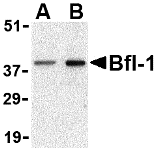
Left: Western blot analysis of Bfl-1 in mouse kidney tissue lysate with Bfl-1 antibody at (A) 1 and (B) 2 µg/ml. Below: Immunohistochemistry of Bfl-1 in mouse kidney tissue with Bfl-1 antibody at 2 µg/ml.
Source : Bfl-1 antibody was raised against a 14 amino acid peptide from near the amino terminus of human Bfl-1.
Purification : Affinity chromatography purified via peptide column
Clonality and Clone : This is a polyclonal antibody.
Host : Bfl-1 antibody was raised in rabbit.
Tested Application(s) : E, WB
Buffer : Antibody is supplied in PBS containing 0.02% sodium azide.
Blocking Peptide : Cat.No. 3875P - Bfl-1 Peptide
Long-Term Storage : Bfl-1 antibody can be stored at 4ºC, stable for one year. As with all antibodies care should be taken to avoid repeated freeze thaw cycles. Antibodies should not be exposed to prolonged high temperatures.
Positive Control
Cat. No. 1405 - Mouse Kidney Tissue Lysate
Species Reactivity :H, M, R
GI Number : 4757840
Accession Number : NP_004040
Short Description : (NT) Bcl-2, apoptosis, cell death, Bax
References
- Lockshin RA, Osborne B, and Zakeri Z. Cell death in the third millennium. Cell Death Differ. 2000; 7:2-7.
- Choi SS, Park IC, Yun JW, et al. A novel Bcl-2 related gene, Bfl-1, is overexpressed in stomach cancer and preferentially expressed in bone marrow. Oncogene 1995; 11:1693-8.
- Kim JK, Kim KD, Lee E, et al. Up-regulation of Bfl-1/A1 via NF-kappaB activation in cisplatin-resistant human bladder cancer cell line. Cancer Lett. 2004; 212:61-70.
- Zhang H, Cowan-Jacob SW, Simonen M, et al. Structural basis of BFL-1 for its interaction with BAX and its anti-apoptotic action in mammalian and yeast cells. J. Biol. Chem. 2000; 275:11092-9.
For more detail regarding Peptide please visit here : Custom Peptide Synthesis
Bfl-1 Antibody
Catalog# : 3873
Apoptosis plays a major role in normal organism development, tissue homeostasis, and removal of damaged cells and is caused by caspase activation. Proteins that comprise the Bcl-2 family appear to control the activation of these enzymes. One such member is multi-domain antiapoptotic protein Bfl-1, which is overexpressed in stomach and other cancers. Bfl-1 can interact with Bax and suppress apoptosis by inhibiting the release of cytochrome c and caspase-3 activation. It is upregulated in cisplatin-resistant human bladder tumor, suggesting that its expression may be important for cisplatin resistance and inhibition of apoptosis in cancer cells. At least two isoforms of Bfl-1 are known to exist. Presumably due to post-translational modifications, Bfl-1 is often observed at higher molecular weight in SDS-PAGE than its predicted molecular weight would suggest.
Additional Names : Bfl-1 (CT), Bcl-2-related protein A1, Hemopoietic-specific early response protein
 Description
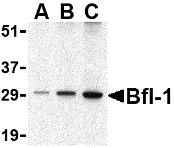
Left: Western blot analysis of Bfl-1 in human kidney tissue lysate with Bfl-1 antibody at (A) 0.5, (B) 1 and (C) 2 µg/ml. Below: Immunohistochemistry of Bfl-1 in mouse kidney tissue with Bfl-1 antibody at 10 µg/ml.
Source : Bfl-1 antibody was raised against a 14 amino acid peptide from near the carboxy terminus of human Bfl-1.
Purification : Affinity chromatography purified via peptide column
Clonality and Clone : This is a polyclonal antibody.
Host : Bfl-1 antibody was raised in rabbit.
Application : Rabbit polyclonal Bfl-1 antibo
Tested Application(s) : E, WB, IHC
Buffer : Antibody is supplied in PBS containing 0.02% sodium azide.
Blocking Peptide : Cat.No. 3873P - Bfl-1 Peptide
Long-Term Storage : Bfl-1 antibody can be stored at 4ºC, stable for one year. As with all antibodies care should be taken to avoid repeated freeze thaw cycles. Antibodies should not be exposed to prolonged high temperatures.
Positive Control
- Cat. No. 1305 - Human Kidney Tissue Lysate
- Cat. No. 1405 - Mouse Kidney Tissue Lysate
Species Reactivity :H, M
GI Number : 4757840
Accession Number : NP_004040
Short Description : (CT) Bcl-2, apoptosis, cell death, Bax
References
- Lockshin RA, Osborne B, and Zakeri Z. Cell death in the third millennium. Cell Death Differ. 2000; 7:2-7.
- Choi SS, Park IC, Yun JW, et al. A novel Bcl-2 related gene, Bfl-1, is overexpressed in stomach cancer and preferentially expressed in bone marrow. Oncogene 1995; 11:1693-8.
- Kim JK, Kim KD, Lee E, et al. Up-regulation of Bfl-1/A1 via NF-kappaB activation in cisplatin-resistant human bladder cancer cell line. Cancer Lett. 2004; 212:61-70.
- Zhang H, Cowan-Jacob SW, Simonen M, et al. Structural basis of BFL-1 for its interaction with BAX and its anti-apoptotic action in mammalian and yeast cells. J. Biol. Chem. 2000; 275:11092-9
For more detail regarding Peptide please visit here : Custom Peptide Synthesis
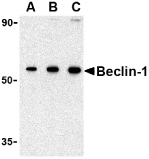
Beclin-1 Antibody Catalog# : 3613 Autophagy, the process of bulk degradation of cellular proteins through an autophagosomic-lysosomal pathway is important for normal growth control and may be defective in tumor cells (1,2). Beclin-1, a coiled-coil Bcl-2-interacting protein homologous to the yeast autophagy gene apg6 (3,4), is a mammalian autophagy gene that can inhibit tumorigenesis and is expressed at reduced levels in human breast carcinoma, suggesting that defects in autophagy proteins may contribute to the development or progression of tumors (5). Bcl-2 can bind to Beclin-1 and inhibit Beclin-1-dependent autophagy in yeast and mammalian cells, suggesting that Bcl-2 functions as an anti-autophagy protein as well as an anti-apoptotic protein, which helps maintain autophagy at levels that are more compatible with cell survival rather than cell death (6). Additional Names : Beclin-1, Coiled-coil myosin-like Bcl-2-interacting protein  Description Left: Western blot analysis of Beclin-1 in 293 cell lysate with Beclin-1 antibody at (A) 0.5, (B) 1 and (C) 2 µg/ml. Below: Immunohistochemistry of beclin-1 in rat brain tissue with beclin-1 antibody at 2 µg/ml. Source :Beclin-1 antibody was raised against a 17 amino acid peptide from near the amino terminus of human Beclin-1. Purification : Affinity chromatography purified via peptide column Clonality and Clone : This is a polyclonal antibody. Host : Beclin-1 antibody was raised in rabbit. Immunogen : Human Beclin-1 / Coiled-coil myosin-like Bcl-2-interacting protein (N-Terminus) Peptide (Cat. No. 36 Tested Application(s) : E, WB, IHC Buffer : Antibody is supplied in PBS containing 0.02% sodium azide. Blocking Peptide : Cat. No. 3613P - Beclin-1 Peptide Long-Term Storage : Beclin-1 antibody can be stored at 4ºC, stable for one year. As with all antibodies care should be taken to avoid repeated freeze thaw cycles. Antibodies should not be exposed to prolonged high temperatures. Positive Control Cat. No. 1210 - 293 Cell Lysate Cat. No. 1403 - Mouse Brain Tissue Lysate Species Reactivity :H, M, R GI Number : 16307457 Accession Number : AAH10276 Short Description : An autophagy related protein References
- Gozuacik D and Kimchi A. Autophagy as a cell death and tumor suppressor mechanism. Oncogene. 2004; 23:2891-906.
- Kisen GO, Tessitore L, Costelli P, et al. Reduced autophagic activity in primary rat hepatocellular carcinoma and ascites hepatoma cells. Carcinogenesis 1993; 14:2501-5.
- Liang XH, Kleeman LK, Jiang HH, et al. Protection against fatal Sindbis virus encephalitis by Beclin, a novel Bcl-2-interacting protein. J. Virol. 1998; 72:8586-96.
- Kametaka S, Okano T, Ohsumi M, et al. Apg14p and Apg6/Vps30p form a protein complex essential for autophagy in the yeast Saccharomyces cerevisiae. J. Biol. Chem. 1998; 273:22284-91.
For more detail regarding Peptide please visit here : Custom Peptide Synthesis

 Description