Tuesday, July 20, 2010

EndoG Monoclonal Antibody

EndoG Monoclonal Antibody

Catalog# : PM-4579

The fragmentation of nuclear DNA is a hallmark of apoptotic cell death. The activities of caspase and nuclease are involved in the DNA fragmentation. Caspase-activated deoxyribonuclease (CAD), also termed DNA fragmentation factor (DFF40), is one such nuclease, and is capable of inducing DNA fragmentation and chromatin condensation after cleavage by caspase-3 of its inhibitor ICAD/DFF45. Caspase and CAD independent DNA fragmentation also exists. Recent studies demonstrated that another nuclease, endonuclease G (EndoG), is specifically activated by apoptotic stimuli and is able to induce nucleosomal fragmentation of DNA independently of caspase and DFF/CAD. EndoG is a mitochondrion-specific nuclease that translocates to the nucleus and cleaves chromatin DNA during apoptosis. The homologue of mammalian EndoG is the first mitochondrial protein identified to be involved in apoptosis in C. elegans. EndoG also cleaves DNA in vitro.

Additional Names : EndoG (7G1G10): Endonuclease G
Description
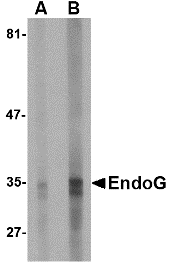
Left: Western blot analysis of EndoG expression in HepG2 cell lysate with EndoG antibody at (A) 5 and (B) 10 µg/ml.


Source : Mouse monoclonal EndoG antibody was raised against a recombinant protein corresponding to amino acids 51 – 140 of human EndoG.

Purification : Immunoaffinity chromotography purified IgG

Clonality and Clone : This is a monoclonal antibody. (Clone 7G1G10)

Host : EndoG monoclonal antibody was raised in mouse. Please use anti-rabbit secondary antibodies.

Immunogen : Recombinant protein corresponding to amino acids 51 – 140 of human EndoG.

Application : EndoG monoclonal antibody can be used for detection of EndoG by Western blot at 5 – 10 µg/ml.

Tested Application(s) : E, WB

Buffer : Antibody is supplied in PBS containing 0.02% sodium azide.

Long-Term Storage : EndoG monoclonal antibody can be stored at 4ºC, stable for one year.

Positive Control
1.Cat. No. 1211 - HepG2 Cell Lysate
2.Cat. No. 95-103 - EndoG Recombinant Protein

Species Reactivity :H, R

Short Description : Endonclease G

References
1.Li LY, Luo X, Wang X. Endonuclease G is an apoptotic DNase when released from mitochondria. Nature 2001; 412:95-9.
2.Parrish J, Li L, Klotz K, et al. Mitochondrial endonuclease G is important for apoptosis in C. elegans. Nature 2001; 412:90-4
3.Hengartner MO. Apoptosis. DNA destroyers. Nature 2001; 412:27, 29.
4.Widlak P, Li LY, Wang X, et al. Action of recombinant human apoptotic endonuclease G on naked DNA and chromatin substrates: cooperation with exonuclease and DNase I. J. Biol. Chem. 2001; 276:48404-9.

EndoG Monoclonal Antibody

EndoG Monoclonal Antibody

Catalog# : PM-4577

The fragmentation of nuclear DNA is a hallmark of apoptotic cell death. The activities of caspase and nuclease are involved in the DNA fragmentation. Caspase-activated deoxyribonuclease (CAD), also termed DNA fragmentation factor (DFF40), is one such nuclease, and is capable of inducing DNA fragmentation and chromatin condensation after cleavage by caspase-3 of its inhibitor ICAD/DFF45. Caspase and CAD independent DNA fragmentation also exists. Recent studies demonstrated that another nuclease, endonuclease G (EndoG), is specifically activated by apoptotic stimuli and is able to induce nucleosomal fragmentation of DNA independently of caspase and DFF/CAD. EndoG is a mitochondrion-specific nuclease that translocates to the nucleus and cleaves chromatin DNA during apoptosis. The homologue of mammalian EndoG is the first mitochondrial protein identified to be involved in apoptosis in C. elegans. EndoG also cleaves DNA in vitro.

Additional Names : EndoG (7G1C10): Endonuclease G
Description
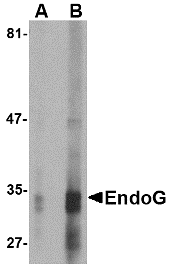
Left: Western blot analysis of EndoG expression in HepG2 cell lysate with EndoG antibody at (A) 2.5 and (B) 5 µg/ml.


Source : Mouse monoclonal EndoG antibody was raised against a recombinant protein corresponding to amino acids 51 – 140 of human EndoG.

Purification : Immunoaffinity chromotography purified IgG

Clonality and Clone : This is a monoclonal antibody. (Clone 7G1C10)

Host : EndoG monoclonal antibody was raised in mouse.Please use anti-rabbit secondary antibodies.

Immunogen : Recombinant protein corresponding to amino acids 51 – 140 of human EndoG.

Application : EndoG monoclonal antibody can be used for detection of EndoG by Western blot at 2.5 – 5 µg/ml.

Tested Application(s) : E, WB

Buffer : Antibody is supplied in PBS containing 0.02% sodium azide.

Long-Term Storage : EndoG monoclonal antibody can be stored at 4ºC, stable for one year.

Positive Control
1.Cat. No. 1211 - HepG2 Cell Lysate
2.Cat. No. 95-103 - EndoG Recombinant Protein

Species Reactivity :H, M, R

Short Description : Endonclease G

References
1.Li LY, Luo X, Wang X. Endonuclease G is an apoptotic DNase when released from mitochondria. Nature 2001; 412:95-9.
2.Parrish J, Li L, Klotz K, et al. Mitochondrial endonuclease G is important for apoptosis in C. elegans. Nature 2001; 412:90-4
3.Hengartner MO. Apoptosis. DNA destroyers. Nature 2001; 412:27, 29.
4.Widlak P, Li LY, Wang X, et al. Action of recombinant human apoptotic endonuclease G on naked DNA and chromatin substrates: cooperation with exonuclease and DNase I. J. Biol. Chem. 2001; 276:48404-9.
EndoG Antibody

EndoG Antibody

Catalog# : 3035

The fragmentation of nuclear DNA is a hallmark of apoptotic cell death. The activities of caspase and nuclease are involved in the DNA fragmentation. Caspase-activated deoxyribonuclease (CAD), also termed DNA fragmentation factor (DFF40), is one such nuclease, and is capable of inducing DNA fragmentation and chromatin condensation after cleavage by caspase-3 of its inhibitor ICAD/DFF45. Caspase and CAD independent DNA fragmentation also exists. Recent studies demonstrated that another nuclease, endonuclease G (endoG), is specifically activated by apoptotic stimuli and is able to induce nucleosomal fragmentation of DNA independently of caspase and DFF/CAD (1,2). EndoG is a mitochondrion-specific nuclease that translocates to the nucleus and cleaves chromatin DNA during apoptosis. The homologue of mammalian EndoG is the first mitochondrial protein identified to be involved in apoptosis in C. elegans (2). EndooG also cleaves DNA in vitro (4).

Additional Names : EndoG

Description
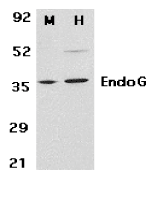
Left: Western blot analysis of EndoG in mouse (M) 3T3 and human (H) HepG2 cell lysates with EndoG antibody at 2 µg/ml.

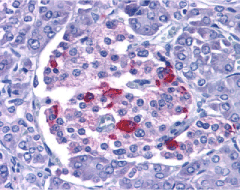
Below: Immunohistochemistry of EndoG in human pancreas with EndoG antibody at 15 µg/ml.

Other Product Images

Source : EndoG antibody was raised with a synthetic peptide corresponding to 15 amino acids near the amino terminus of human EndoG.

Purification : Affinity chromatography purified via peptide column

Clonality and Clone : This is a polyclonal antibody.

Host : EndoG antibody was raised in rabbit. Please use anti-rabbit secondary antibodies.

Immunogen : Human EndoG Peptide (Cat. No. 3035P)

Application : EndoG antibody can be used for detection of EndoG by Western blot at 1 to 2 µg/ml.HepG2 and 3T3 cell lysates can be used as positive control and a 35 kDa band can be detected. It is human, mouse and rat reactive.

Tested Application(s) : E, WB, IHC

Buffer : Antibody is supplied in PBS containing 0.02% sodium azide.

Blocking Peptide : Cat. No. 3035P - EndoG Peptide

Long-Term Storage : EndoG antibody can be stored at 4ºC, stable for one year. As with all antibodies care should be taken to avoid repeated freeze thaw cycles. Antibodies should not be exposed to prolonged high temperatures.

Positive Control
1.Cat. No. 1211 - HepG2 Cell Lysate
2.Cat. No. 1212 - 3T3 Whole Cell Lysate
3.Cat. No. 1307 - Human Pancreas Tissue Lysate

Species Reactivity :H, M, R

GI Number : 53759134

Accession Number : NP_004426

Short Description : Endonuclease G

References
1.Li LY, Luo X, Wang X. Endonuclease G is an apoptotic DNase when released from mitochondria. Nature. 2001;412(6842):95-9.
2.Parrish J, Li L, Klotz K, Ledwich D, Wang X, Xue D. Mitochondrial endonuclease G is important for apoptosis in C. elegans. Nature. 2001;412(6842):90-4
3.Hengartner MO. Apoptosis. DNA destroyers. Nature. 2001;412(6842):27, 29.
4.Widlak P, Li LY, Wang X, Garrard WT. Action of recombinant human apoptotic endonuclease G on naked DNA and chromatin substrates: cooperation with exonuclease and DNase I. J Biol Chem. 2001;276(51):48404-9.

DRAM Antibody

DRAM Antibody

Catalog# : 4035

Damage-regulated autophagy modulator (DRAM) is a p53 target gene encoding a lysosomal protein that induces autophagy, a process that degrades cytosolic proteins and organelles. It has been suggested that activation of DRAM by p53 is simultaneous to the activation by p53 of one or more proapoptotic genes such as PUMA, Bax, etc., and that the signaling pathways regulated by these genes together promote a full cell death response. By itself, DRAM cannot induce apoptosis, but the fact that it is inactivated in certain cancers highlights the importance of DRAM and suggests that autophagy may play a more important role in cancer than initially suspected. At least two different isoforms of DRAM are known to exist.

Additional Names : DRAM (NT), Damage-regulated autophagy modulator

Description
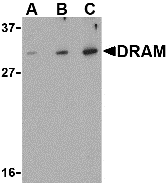
Left: Western blot analysis of DRAM in K562 cell lysate with DRAM antibody at (A) 0.5, (B) 1 and (C) 2 µg/ml.

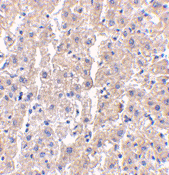
Below: Immunohistochemistry of DRAM in human liver tissue with DRAM antibody at 2.5 µg/ml.

Other Product Images
Source : DRAM antibody was raised against a 16 amino acid peptide from near the amino terminus of human DRAM.

Purification : Affinity chromatography purified via peptide column

Clonality and Clone : This is a polyclonal antibody.

Host : DRAM antibody was raised in rabbit. Please use anti-rabbit secondary antibodies.

Application : DRAM antibody can be used for detection of DRAM by Western blot at 0.5 – 1 µg/ml.

Tested Application(s) : E, WB, IHC

Buffer : Antibody is supplied in PBS containing 0.02% sodium azide.

Blocking Peptide : Cat.No. 4035P - DRAM Peptide

Long-Term Storage : DRAM antibody can be stored at 4ºC, stable for one year. As with all antibodies care should be taken to avoid repeated freeze thaw cycles. Antibodies should not be exposed to prolonged high temperatures.

Positive Control
1.Cat. No. 1204 - K562 Cell Lysate
2.Cat. No. 1304 - Human Liver Tissue Lysate

Species Reactivity :H, M, R

GI Number : 22450862

Accession Number : AAH18435

Short Description : (NT) Damage-regulated autophagy modulator

References
1.Crighton D, Wilkinson S, O’Prey J, et al. DRAM, a p53-induced modulator of autophagy, is critical for apoptosis. Cell 2006; 126:121-34.
2.Gozuacik D and Kimchi A. Autophagy as a cell death and tumor suppressor mechanism. Oncogene. 2004; 23:2891-906.
3.Crighton D, Wilkinson S, and Ryan KM. DRAM links autophagy to p53 and programmed cell death. Autophagy 2007; 3:72-4. (07-01D)

Custom DNA Synthesis

BSI offers DNA base synthesis in phosphodiester, phosphorothioate and methylphosphonate backbones. We offer an extensive selection of purifications and oligo modifications, such as linkers, spacers, dyes and modified bases. Also available:

* Custom oligonucleotide preparative and analytical services
* Long oligonucleotide synthesis for gene expression
* Antisense oligonucleotide synthesis
* Large scale ASR oligonucleotide productions

As always, every custom oligonucleotide synthesis is: All of our custom oligonucleotide products are:

Deprotected, desalted, lyophilized, Ready-2-Use
Quantitated 2x by UV spectrophotometry to provide an accurate measure of yield
QC checked by mass spectrometry
Fast delivery with high throughput capacity

Standard DNA (2' Deoxy) Oligonucleotide Synthesis


Unmodified Standard DNA Purifications


Unmodified Standard DNA Purifications Yields

Monday, July 19, 2010

ProteoSpin Total Protein Concentration Kit

ProteoSpin Total Protein Concentration Kit

Catalog# : NB-22000
Purity : Purity > 95% by HPLC
Solubility : Distilled water for a solution up to 2 mg/ml, otherwise we recommend using DMSO
Format : Each vial contains lyophilized solid packaged and supplied as a trifluoroacetate salt
Price/Unit : $230.00
Unit : 25 preps

For the rapid concentration and desalting of proteins

* Simultaneous concentration and desalting of proteins.
* No molecular weight cutoff.
* Rapid and convenient spin-column format.

The ProteoSpinTM Total Protein Concentration Micro Kit provides a fast and a simple procedure for the concentration of protein samples many fold in a convenient spin column format. The kit employs an innovative separation material that is able to concentrate proteins and peptides while simultaneoulsy removing salts and other contaminants such as detergents and denaturants. One major advantage to this kit is there is no molecular weight cut-off, unlike other products from other vendors. Therefore a broad size range of proteins from peptides to antibodies can be processed. Another advantage of this kit is that it concentrates, removes salts and offers buffer exchange at the same time, whereas other products do these processes as separate procedures and therefore saves considerable time and expense.

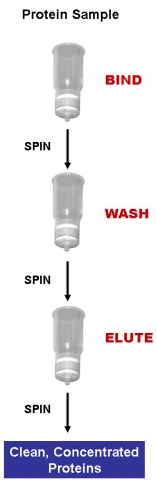
The kit employs a proprietary matrix which acts as an ion exchanger and is able to concentrate proteins many fold as well as remove salts. Breifly, pH Binding Buffer is added to the protein sample and the sample is applied to Bio-Synthesis' column (BIND). Under these conditions the proteins will bind to the column while salts and other contaminants are removed in the flowthrough. The bound proteins are then washed to remove any remaining impurities (WASH). Lastly, the clean proteins are eluted into a small volume of the provided Elution Buffer or into other optional elution buffers (user-provided) (ELUTE). Please see the procedure flowchart to the right.

Each spin column can process up to 200 µg of protein. The kit can efficiently process 12 samples in only 20 minutes using an easy-to use protocol. The percentage of protein recovery is up to 99%, and the percentage of salt removal is up to 99%. The concentrated proteins are ready for any downstream proteomic applications including 2D SDS-PAGE, Whole protein mass spectrometry, Isoelectric focusing, X-ray crystallography, NMR spectroscopy and Protein microarrays

FEATURES AND BENEFITS

* Fast and easy processing - Efficiently process 12 samples in only 20 minutes using an easy-to-use protocol.
* High yield - Recovery of up to 99% of input amount.
* No mixing or formulation - Solutions and protocols are provided with no need for formulation.
* No molecular weight cutoff - Based on an ion exchange mechanism, a broad size range of proteins (from peptides to large proteins) can be processed.
* Proteins bind while salts are discarded in flowthrough - Bio-Synthesis' resin has an inherent low affinity for salt but high affinity for proteins, providing salt removal and buffer exchange simultaneously.
* Suitable for downstream applications - Final elution performed with volatile or non-volatile buffers suitable for: Mass spectrometry, SDS-PAGE, Isoelectric focusing, X-ray crystallography, NMR spectroscopy.

APPLICATIONS

Final elution performed with volatile or non-volatile buffers suitable for:

* Mass spectrometry
* SDS-PAGE
* Isoelectric focusing
* X-ray crystallography
* NMR spectroscopy
Total Protein Concentration Kit Contents
1 Column Activation and Wash Buffer
2 pH Binding Buffer
3 Elution Buffer
4 Neutralizer
5 Micro Spin Columns (25)
6 Collection Tubes (25)
7 Elution Tubes (25)
8 Product Insert

Storage Conditions

Unopened solutions should be stored at room temperature. Once opened, the solutions should be stored at 4°C when not in use.
Long-Term Storage : Store the peptide at -20°C. Keep container tightly
Product Usage
For laboratory research use only, not for diagnostic use! Not for use in humans.

ProteoSpin Detergent Clean-Up Micro Kit

ProteoSpin Detergent Clean-Up Micro Kit

Catalog# : NB-10200
Price/Unit : $255.00
Unit : 25 preps

For the rapid and simple removal of detergents from protein samples

* Concentrate protein samples and remove detergents at the same time
* Effectively remove a wide range of detergents
* Fast processing time, rapid spin-column format

The ProteoSpin™ Detergent Clean-Up Micro Kit removes detergents from protein samples while concentraing the sample at the same time. The kit employs a novel spin column technology that offers convenience, speed, and ease-of-use. The kit can remove trace amounts of detergents from protein samples while maintaining high protein recovery. All types of detergents including ionic, non-ionic and zwitterionic detergents can be effeciently removed in a very short time, eliminating the need for for labourious procedures such as dialysis. The kit is designed to remove detergents in protein solutions either in their free form or bound form, as when complexed with the protein. Also, unlike other commercially available kits that can only remove a single detergent and often do not remove denaturants, the ProteoSpin™ Detergent Clean-Up Micro Kit removes a variety of detergents and denturants that may be used during the purification of the protein sample while providing high protein recovery.

The kit employs a prorietary matrix to remove detergents from protein samples. Breifly, pH Binding Buffer is added to the protein sample and the sample is applied to Bio-Synthesis's column (BIND). Under these conditions the proteins will bind to the column while detergents and other contaminants are removed in the flowthrough. The bound proteins are then washed to remove any remaining impurities (WASH). Lastly, the clean proteins are eluted into a small volume of the provided Elution Buffer or into other optional elution buffers (user-provided) (ELUTE). Please see the procedure flowchart to the right.

No further purification of the protein sample is required after detergent removal, and it can be used directly in a variety of downstream applications including mass spectrometry, SDS-PAGE, isoelectric focusing, and NMR spectroscopy. This kit also offers the additional advantage of fractionating basic proteins from a protein solution, thereby allowing for additional purification of that basic proteins from other contaminating acidic proteins.


FEATURES AND BENEFITS

* Remove a variety of detergents - Detergents including SDS, Triton® X-100, CHAPS, NP-40, Triton® X-114 and Tween 20 can be removed using the kit.
* Effective detergent removal - Detergent removal of greater than 95% for many protein samples, allowing for detergent-sensitive tryptic digestion. Can also remove detergents that are complexed with proteins.
* Complete kit - The ProteoSpin™ Total Protein Detergent Clean-Up Micro Kit contains all the solutions and columns for the processing of 25 total protein samples. Each spin column is able to process 50 µg of either acidic or basic protein
* Fast and easy processing - Preparation time for 12 samples is only 20 minutes.
* Eluted proteins can be used directly in downstream applications - No need for additional sample preparation procedures for downstream applications. Concentrate protein sample and remove detergents at the same time.
* No detergent carryover - Each sample is processed individually using its own spin column, resulting in no carryover or column bleed from sample to sample.
* Ready-to-use columns - No purging, swelling of resin, or lengthy activation steps required.

APPLICATIONS

The purified proteins are suitable for a number of downstream applications such as:

* 2D SDS-PAGE
* Whole protein mass spectrometry
* Isoelectric focusing
* X-ray crystallography
* NMR spectroscopy
* Protein microarrays

Table 1. Efficient Removal of SDS

Removal of SDS with the ProteoSpin™ Detergent Clean-Up Micro Kit is greater than 99%. To evaluate this, 50 µg samples of BSA were spiked with 0.1% SDS and processed using the kit. The protocol was followed, and the proteins were bound, washed and eluted as described. The purified protein was then assayed for SDS using the Detergent-OUT kit by Geno Technologies, Inc, and SDS removal was found to be greater than 99%.

ProteoSpin Detergent Clean-Up Micro Kit Contents
1.Column Activation and Wash Buffer for Acidic Proteins
2.pH Binding Buffer for Acidic Proteins
3.Column Activation and Wash Buffer for Basic Proteins
4.pH Binding Buffer for Basic Proteins
5.Elution Buffer
6.Neutralizer
7.Micro Spin Columns (25)
8.Elution Tubes (25)
9.Product Insert
Long-Term Storage : Unopened solutions should be stored at room temperature. Once opened, the solutions should be stored at 4°C when not in use, except for the Basic and Acidic Binding Buffers, which should be stored at room temperature.
Product Usage
For laboratory research use only, not for diagnostic use! Not for use in humans.

ProteoSpin Detergent Clean-Up Maxi Kit

ProteoSpin Detergent Clean-Up Maxi Kit

Alternate Name:
Catalog# : NB-17100
Price/Unit : $154.00
Unit : 4 preps

For fast and simple removal of detergents from protein samples

* Concentrate protein samples and remove detergents at the same time
* Rapid and convenient spin-column protocol
* Effectively remove a wide range of detergents including SDS, Triton® X-100, CHAPS, NP-40, and Tween 20

The ProteoSpin™ Detergent Clean-Up Maxi Kit removes up to 99.99% of detergents from protein samples while maintaining high protein recovery. The kit employs spin column technology that offers convenience, speed, and ease-of-use. All types of detergents including ionic, non-ionic and zwitterionic detergents can be effeciently removed in a very short time, eliminating the need for for labourious procedures such as dialysis. The kit is designed to remove detergents in protein solutions either in their free form or bound form, as when complexed with the protein. Also, unlike other commercially available kits that can only handle one detergent and often do not remove denaturants, the ProteoSpin™ Detergent Clean-Up Micro Kit removes a variety of detergents and denturants that may be used during the purification of the protein sample while providing high protein recovery.

Breifly, pH Binding Buffer is added to the protein sample and the sample is applied to Bio-Synthesis's column (BIND). Under these conditions the proteins will bind to the column while detergents and other contaminants are removed in the flowthrough. The bound proteins are then washed to remove any remaining impurities (WASH). Lastly, the clean proteins are eluted into a small volume of the provided Elution Buffer or into other optional elution buffers (user-provided) (ELUTE). Please see the procedure flowchart to the right.

No further cleaning of the protein sample is required and can be used directly in a variety of downstream applications including mass spectrometry, SDS-PAGE, isoelectric focusing, and NMR spectroscopy. The kit employs a proprietary matrix, which acts as an ion exchanger This kit offers an additional advantage in that basic proteins can be factionated separately if the pI of the protein is known to be above pH 7. This gives further purification from other contaminating acidic proteins.
FEATURES AND BENEFITS

* Fast and easy processing - In contrast to longer procedures such as dialysis, this easy-to-use procedure allows for the processing of 4 samples in only 40 minutes.
* No detergent carryover - Each sample is processed individually using its own spin column, resulting in no carryover or column bleed from sample to sample.
* Usable with a variety of detergents - Remove detergents including SDS, Triton® X-100, CHAPS, NP-40, Triton® X-114 and Tween 20
* Efficient detergent removal - Removes more than 95% of detergents, including detergents that are complexed (bound) with proteins
* Detergent-free samples are ready to use - No need for additional sample preparation procedures for downstream applications
* Ready-to-use columns - No purging, swelling of resin, or any other lengthy preactivation

APPLICATIONS

The purified proteins are suitable for a number of downstream applications such as:

* 2D (Two Dimensional) SDS-PAGE
* Whole protein mass spectrometry
* Isoelectric focusing
* X-ray crystallography
* NMR spectroscopy
* Protein microarrays.

Detergent Clean-Up Maxi Kit Contents
1.Column Activation and Wash Buffer for Acidic Proteins
2.pH Binding Buffer for Acidic Proteins
3.Column Activation and Wash Buffer for Basic Proteins
4.pH Binding Buffer for Basic Proteins
5.Elution Buffer
6.Neutralizer
7.Micro Spin Columns (4)
8.Elution Tubes (4)
9.Product Insert

Long-Term Storage : Unopened solutions should be stored at room temperature. Once opened, the solutions should be stored at 4°C when not in use, except for the Basic and Acidic Binding Buffers, which should be stored at room temperature.
Product Usage
For laboratory research use only, not for diagnostic use! Not for use in humans.

ProteoSpin CBED MAXI Kit ((Concentration, Buffer Exchange and Desalting )

ProteoSpin CBED MAXI Kit ((Concentration, Buffer Exchange and Desalting )

Catalog# : NB-17000
Price/Unit : $154.00
Unit : 4 preps

For rapid and efficient concentration and desalting of protein samples

* Protein recovery up to 99%
* Up to 99% removal of salts
* Fast processing time, rapid spin-column format

The ProteoSpin™ CBED Maxi Kit provides a fast and a simple procedure for concentration, buffer exchange and desalting of protein samples based on spin column chromatography. The ProteoSpin™ CBED Maxi Kit comes with solutions for concentrating and desalting both acidic and basic proteins. Two procedures, one for acidic proteins and another for basic proteins, are described.

The kit employs an innovative separation matrix, which acts as an ion exchanger, and is able to concentrate proteins many fold as well as removes salts. Breifly, pH Binding Buffer is added to the protein sample and the sample is applied to Bio-Synthesis's column (BIND). Under these conditions the proteins will bind to the column while salts and other contaminants are removed in the flowthrough. The bound proteins are then washed to remove any remaining impurities (WASH) Lastly, the clean proteins are eluted into a small volume of the provided Elution Buffer or into other optional elution buffers (user-provided) (ELUTE). Please see the procedure flowchart to the right.

One major advantage to this kit is there is no molecular weight cut-off, unlike products from other vendors. A broad size range of proteins, from peptides to antibodies can be processed. Salts such as MgCl2, NaCl, KCl, CaCl2, LiCl, and CsCl have poor affinities for Bio-Synthesis's proprietary resin and are easily removed from the sample. Another advantage over other vendor products is that the ProteoSpin™ CBED Micro Kit concentrates, removes salts and offers buffer exchange at the same time, whereas other products including dialysis do these processes as separate procedures. The ProteoSpin™ CBED Micro Kit therefore saves considerable time and expense.

The kit can efficiently process 4 samples in only 20 minutes using an easy-to use protocol. The percentage of protein recovery is up to 99%, whereas the percentage of salt removal is up to 99%. The concentrated proteins are ready for any downstream proteomic applications including 2D SDS-PAGE, Whole protein mass spectrometry, Isoelectric focusing, X-ray crystallography, NMR spectroscopyand Protein microarrays

FEATURES AND BENEFITS

* Fast processing time - Process 4 samples in only 20 minutes, compared to other lengthy concentrating and desalting methods.
* Efficient salt removal - Remove up to 99% of salts
* High protein recovery - Recover up to 99% of protein input
* No molecular weight cutoff - Based on an ion-exchange mechanism, a broad size range of proteins from peptides to antibodies can be processed
* Ready-to use columns - No column preparations required.
* No special storage conditions - All the kit components can be stored at room temperature
* No mixing or formulation - Solutions and protocols are provided for both acidic and basic proteins with no need for formulation.


APPLICATIONS

The concentrated proteins are ready for any downstream proteomic applications including:

* 2D SDS-PAGE
* Whole protein mass spectrometry
* Isoelectric focusing
* X-ray crystallography
* NMR spectroscopy
* Protein microarrays
CBED Maxi Kit Contents
1.Column Activation and Wash Buffer for Acidic Proteins
2.pH Binding Buffer for Acidic Proteins
3.Column Activation and Wash Buffer for Basic Proteins
4.pH Binding Buffer for Basic Proteins
5.Elution Buffer
6.Neutralizer
7.Micro Spin Columns (4)
8.Elution Tubes (4)
9.Product Insert
Long-Term Storage : Unopened solutions should be stored at room temperature. Once opened, the solutions should be stored at 4°C when not in use, except for the Basic and Acidic Binding Buffers, which should be stored at room temperature.
Product Usage
For laboratory research use only, not for diagnostic use! Not for use in humans.

ProteoSpin CBED (Concentration, Buffer Exchange and Desalting) Micro Kit

ProteoSpin CBED (Concentration, Buffer Exchange and Desalting) Micro Kit

Catalog# : NB-10100
Price/Unit : $255.00
Unit : 25 preps

For rapid and efficient concentration and desalting of protein samples

* Protein recovery of up to 99%
* Up to 99% removal of salts
* Fast processing time, rapid spin-column format

The ProteoSpin™ CBED Micro Kit provides a fast and a simple procedure for concentration, buffer exchange and desalting of protein samples based on spin column technoloy. The ProteoSpin™ CBED Micro Kit comes with solutions for concentrating and desalting both acidic and basic proteins. Two procedures, one for acidic proteins and another for basic proteins, are provided.

The kit employs a proprietary matrix, which acts as an ion exchanger and is able to concentrate proteins many fold as well as remove salts. Breifly, pH Binding Buffer is added to the protein sample and the sample is applied to Bio-Synthesis's column (BIND). Under these conditions the proteins will bind to the column while salts and other contaminants are removed in the flowthrough. The bound proteins are then washed to remove any remaining impurities (WASH). Lastly, the clean proteins are eluted into a small volume of the provided Elution Buffer or into other optional elution buffers (user-provided) (ELUTE). Please see the procedure flowchart to the right.

One major advantage to this kit is there is no molecular weight cut-off, unlike products from other vendors. A broad size range of proteins, from peptides to antibodies can be processed. Salts such as MgCl2, NaCl, KCl, CaCl2, LiCl, and CsCl have poor affinities for Bio-Synthesis's proprietary resin and are easily removed from the sample. Another advantage over other vendor products is that the ProteoSpin™ CBED Micro Kit concentrates, removes salts and offers buffer exchange at the same time, whereas other products including dialysis do these processes as separate procedures. The ProteoSpin™ CBED Micro Kit therefore saves considerable time and expense.

Each spin column can process up to 50 µg of protein in up to 5 mL of solution. The kit can efficiently process 12 samples in only 20 minutes using an easy-to use protocol. The percentage of protein recovery is up to 99%, whereas the percentage of salt removal is up to 99%. The kit allows for the concentration of either basic or acidic proteins separately The concentrated proteins are ready for any downstream proteomic applications including 2D SDS-PAGE, Whole protein mass spectrometry, Isoelectric focusing, X-ray crystallography, NMR spectroscopy and Protein microarrays
FEATURES AND BENEFITS

* Fast processing time - Efficiently process 12 samples in only 20 minutes compared to other concentrating and desalting methods.
* High yield - Recovery of up to 99% of input protein amount.
* Efficient salt removal - Remove up tp 99% of salts
* No molecular weight cutoff - Based on an ion-exchange mechanism, a broad size range of proteins from peptides to antibodies can be processed.
* Ready-to-use columns - No column preparations required.
* No special storage conditions - All the kit components can be stored at room temperature
* No mixing or formulation - Solutions and protocols are provided for both acidic and basic proteins with no need for formulation.

CBED Micro Kit Contents
1.Column Activation and Wash Buffer for Acidic Proteins
2.pH Binding Buffer for Acidic Proteins
3.Column Activation and Wash Buffer for Basic Proteins
4.pH Binding Buffer for Basic Proteins
5.Elution Buffer
6.Neutralizer
7.Micro Spin Columns (25)
8.Elution Tubes (25)
9.Product Insert
Long-Term Storage : Unopened solutions should be stored at room temperature. Once opened, the solutions should be stored at 4°C when not in use, except for the Basic and Acidic Binding Buffers, which should be stored at room temperature.
Product Usage
For laboratory research use only, not for diagnostic use! Not for use in humans.